The one-minute guide
What this is about: NSW law requires residential strata schemes to install safety devices on windows that are high enough to pose a fall risk to children. These devices restrict how far a window can open.
Which windows: Any openable window where the lowest part of the opening is less than 1.7 metres above the internal floor level, and the internal floor is 2 metres or more above the ground outside.
What the device must do: Restrict the window opening so that a sphere of 125mm or more (the width of a child's head) cannot pass through, resist an outward force of 250 newtons, and have a child-resistant release mechanism if it can be unlocked or removed.
Who is responsible: The owners corporation. Installation is at the OC's expense. Lot owners can install devices themselves but must notify the OC in writing afterwards.
Penalty for non-compliance: Up to $550 (5 penalty units) per conviction for an OC that fails to comply.
Flyscreens: Standard flyscreens do not comply unless they are specifically reinforced to resist 250 newtons of outward force.
Permanent restriction not required: Devices can be opened fully by adults when children are not present, as long as a complying device is in place and can be re-engaged.
Every year in Australia, children are seriously injured and killed after falling from apartment windows. In almost every case the accident could have been prevented by a simple device that restricts how far the window can open. In 2013 the NSW Government introduced mandatory requirements for strata buildings, and since 13 March 2018 every residential strata scheme in NSW has been required to comply. This article explains what the law requires, who is responsible for what, and what happens when devices are removed, broken, or not installed at all.
| Audience |
Relevance |
Why it matters |
| Strata committee members |
Essential |
The OC bears the compliance obligation and the penalty for non-compliance. If devices are missing or broken, this is the committee's problem to solve promptly. |
| Lot owners |
Important |
Understand your right to install devices in your own lot, your obligation to notify the OC, and what happens if a device in your lot is damaged or removed. |
| Tenants |
Relevant |
You can install devices with your landlord's written consent. You must provide access to the OC to install or inspect devices and must not obstruct that access. |
| Investors and landlords |
Important |
The OC bears the installation cost, but you have practical responsibilities around access and the condition report when leasing. |
TL;DR: NSW law requires residential strata OCs to install complying window safety devices on all high-risk windows at the OC's expense. The devices restrict opening to 12.5cm and must resist 250 newtons of force. Flyscreens do not comply. The OC faces up to $550 (5 penalty units) per conviction for failing to comply.
The legislative framework
The obligation for NSW residential strata schemes to install window safety devices arises from Section 118 of the Strata Schemes Management Act 2015 (NSW) and Regulations 30 and 31 of the Strata Schemes Management Regulation 2016 (NSW). These provisions were introduced by the Strata Schemes Management Amendment (Child Window Safety Devices) Act 2013 and had a compliance deadline of 13 March 2018.
The legislation applies only to strata schemes registered under the SSMA 2015. Company title buildings, community title schemes, neighbourhood associations, detached houses, and unit blocks owned by a single landlord are not covered by these provisions. That said, the obligation to maintain a safe premises under other laws still applies to those buildings, and child window safety is good practice regardless of the legal framework.
TL;DR: Window safety device obligations apply to residential strata schemes under the SSMA 2015 only. Company title, community title, and detached houses are not covered by these specific provisions.
Which windows are covered
Not every window in a strata building is subject to the requirement. Regulation 30 of the SSMR 2016 identifies the windows that must have safety devices installed. A window is covered if both of the following conditions are met:
- Height above external ground: The internal floor of the building at that window location is 2 metres or more above the external surface directly outside (the ground, a balcony, a ledge, or any other surface a person could fall onto).
- Height above internal floor: The lowest part of the window opening is less than 1.7 metres above the internal floor of the room in which the window is located. This captures windows that are within a child's reach.
If both conditions are met, a complying safety device must be installed. Both conditions must be satisfied simultaneously: a window 3 metres above the ground that has its sill 2 metres above the internal floor is not covered (the sill is above a child's reach). Equally, a window with a low sill on the ground floor is not covered (the fall height is less than 2 metres).
Common property windows and lot windows
The requirement covers both common property windows and windows within individual lots. Under Regulation 30(2)(e), windows on common property that can be accessed from a residence, and windows that form part of a residence, are all covered. This means the windows in your apartment, the windows in stairwells accessible from a residence, and other common property windows that meet the height criteria all fall within the obligation.
Windows that are exempt
- Fixed windows (those that do not open at all) do not require a safety device
- Windows where the lowest part of the opening is 1.7 metres or more above the internal floor
- Windows where the floor below is less than 2 metres above the external surface outside
- Windows in buildings that are not residential strata schemes under the SSMA 2015
What about windows onto a balcony?
A window that opens directly onto your own lot's private balcony is generally exempt. The reasoning is that the balcony itself provides a barrier, and the relevant measurement is the height from the balcony floor to the external surface, not from your internal floor to the ground. However, this depends on the specific configuration — if the balcony provides no meaningful barrier or if a child could easily reach the balcony edge, the OC or committee may treat the window as requiring a device regardless. Check with your strata manager if you are uncertain about a specific window.
TL;DR: A window must have a safety device if the internal floor is 2m or more above the ground outside AND the lowest part of the window opening is less than 1.7m above the internal floor. Fixed windows are exempt. Both conditions must apply.
What counts as a complying window safety device
Not any lock or screen will do. Regulation 30(3) of the SSMR 2016 sets out three requirements that a device must meet to be complying:
| Requirement |
What it means in practice |
| Opening restriction — 125mm sphere test |
The device must restrict the window opening so that a sphere of 125 millimetres or more in diameter cannot pass through the window opening. In everyday terms, this means the window can open no more than 12.5 centimetres. This is measured as the maximum gap in any direction — not just the width. |
| Force resistance — 250 newtons |
The device must be capable of resisting an outward horizontal force of 250 newtons. This is approximately the force a child could exert pushing against a window. A device that can be pushed open by a determined child does not comply. |
| Child-resistant release mechanism |
If the device can be removed, overridden, or unlocked, it must have a child-resistant release mechanism. This means a mechanism that requires a key to unlock, a coordinated two-handed operation to release, or the use of a tool such as a screwdriver or spanner to move the device or screen to allow the window to open fully. A simple push-button or thumb-turn release that a child could operate does not comply. |
Types of complying devices
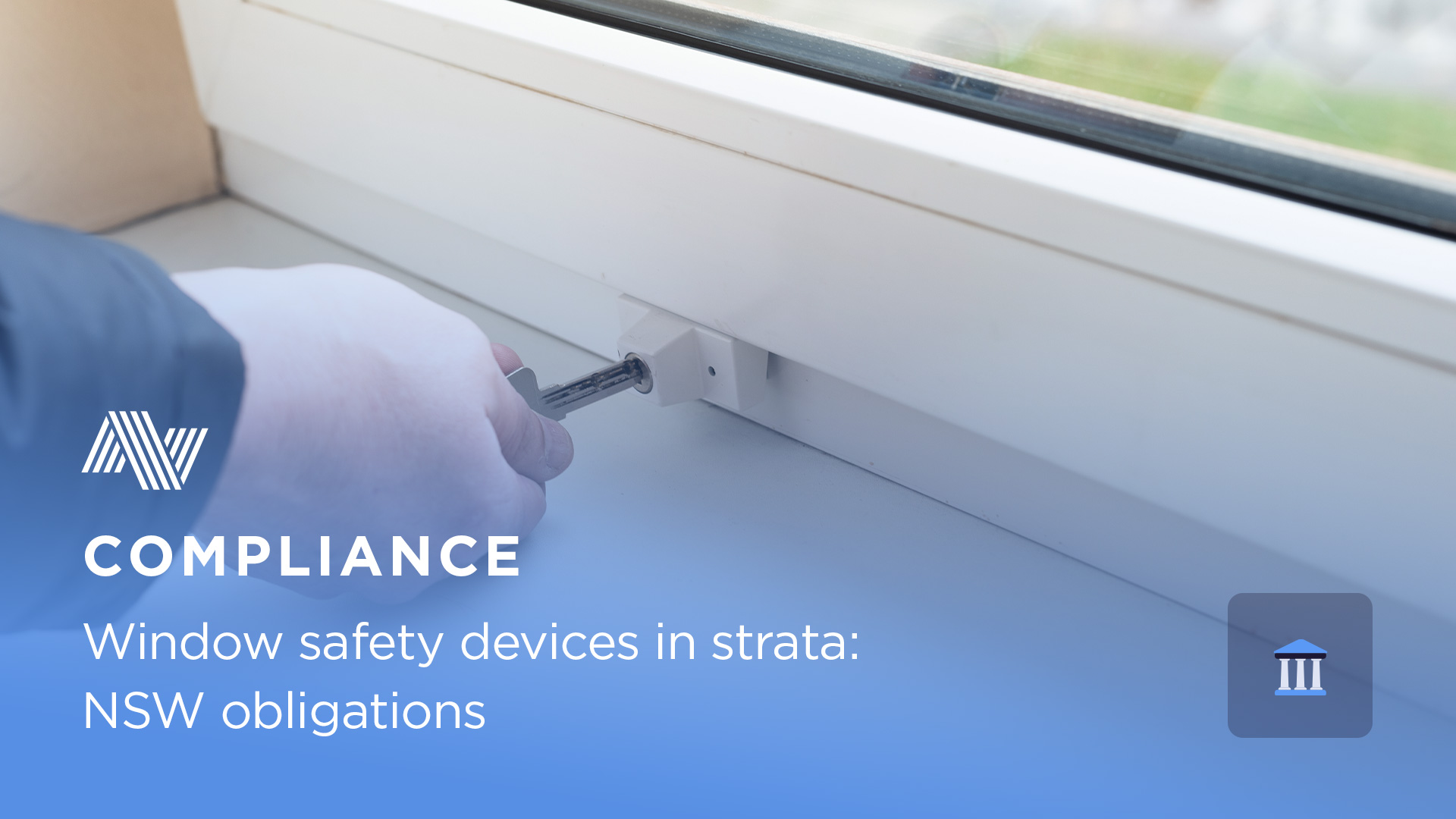
- Window restrictors and locks: The most common type. A lock mechanism that can be set to hold the window at no more than 12.5cm. Most have a key-operated release mechanism that adults can use to open the window fully when needed. The key must be child-resistant.
- Security bars or grilles: Fixed or removable bars or grilles that prevent the window opening beyond 12.5cm, with gaps of less than 12.5cm between bars. These comply if they can resist 250 newtons. If removable, the removal mechanism must be child-resistant.
- Reinforced security screens: Heavy-duty screens that can resist 250 newtons of outward force and restrict opening to 12.5cm. These are distinct from standard flyscreens.
Flyscreens do not comply
Standard flyscreens, no matter how tightly fitted or apparently strong, do not comply with the window safety device requirements. A flyscreen is designed to keep insects out — it is not designed to prevent a child from falling through or pushing through a window. Unless the flyscreen is specifically rated and tested to resist 250 newtons of outward force — which standard flyscreens are not — it does not satisfy the requirements of Regulation 30(3). The OC cannot treat the presence of a flyscreen as compliance with Section 118.
Devices do not need to restrict permanently
A common misconception is that the device must permanently prevent the window from being fully opened. This is not what the law requires. Regulation 30(3)(c) provides that if the device can be removed, overridden, or unlocked, it must have a child-resistant release mechanism. The intention is that adults can open windows fully when children are not present — for cleaning, ventilation, or emergency purposes — as long as the device can be re-engaged and a child could not disengage it without assistance.
The NSW Fair Trading position is that if children do not reside in a particular lot and are not regularly present in the relevant common property area, owners may choose to keep the device disengaged when children are not present. However, the device must still be in place and compliant, so that it can be engaged when children are present.
TL;DR: A complying device must restrict opening to 12.5cm, resist 250 newtons of outward force, and have a child-resistant release mechanism if it can be unlocked or removed. Standard flyscreens do not comply. Devices can be opened fully by adults when children are not present.
Who is responsible for installation and maintenance
The owners corporation: primary obligation
Section 118(1) of the SSMA 2015 places the obligation squarely on the owners corporation. The OC must ensure that there are complying window safety devices on all applicable windows in the scheme. Section 118(2) makes clear that the OC is to carry out this work at its own expense — it cannot pass the cost of initial installation on to lot owners (unless the scheme's by-laws specifically provide otherwise, which is uncommon).
The OC's obligation is ongoing, not a one-time installation exercise. If a device breaks through normal wear and tear, the OC is responsible for repairing or replacing it. If a device is damaged through no fault of an occupant, the repair cost falls to the OC. This is consistent with the OC's general duty to maintain and repair common property.
In practice, devices installed on lot windows that are part of the common property structure (as most apartment windows are) are maintained by the OC as part of common property maintenance. The cost comes from the administrative fund.
What the OC can do to fulfil its obligation
To carry out its obligation under Section 118, the OC (or its strata manager acting under delegated authority) can enter lots to install or inspect window safety devices. Section 122(1)(a) of the Act specifically gives the OC the power to enter any part of the parcel to carry out work required under the Act, and explicitly mentions window safety device work. Section 118(5) also provides that work authorised by Section 118 can be carried out despite any other provision of the Act, regulations, or by-law of the scheme — this means neither the OC nor a lot owner can be blocked by a scheme by-law from installing a complying device.
The OC is still required to give reasonable notice before entering a lot for non-emergency purposes under Section 122 of the Act. A person who obstructs or hinders the OC in carrying out this work can be fined up to $550.
Lot owners: rights and obligations
A lot owner who wishes to install a complying window safety device in their own lot does not need the OC's approval under Section 118(3). They can install the device themselves. However, under Regulation 31, the owner must give written notice to the OC within 7 days after completing the installation. The notice must be given after installation, not before.
The owner who installs the device must repair any damage caused to common property during the installation and ensure that the device is installed properly and looks in keeping with the rest of the building (Section 118(4)).
Can the OC recover costs from lot owners?
Not automatically. Section 118(2) requires the OC to pay for installation. A by-law cannot typically shift the initial installation cost to lot owners. However, if a device is damaged or removed by an occupant (rather than through normal wear and tear), the OC may be able to recover the cost of repair or replacement from that occupant through a by-law specifically providing for cost recovery. Schemes are encouraged to have such a by-law in place before undertaking installation, so the recovery pathway is clear.
Tenants: what they can and cannot do
Tenants can install complying window safety devices in their rental apartment. If the installation requires drilling or other work that could affect common property, the tenant needs prior written permission from the landlord. The landlord cannot unreasonably refuse this request. Tenants must also notify the OC in writing after installing any device.
Tenants must provide access to the OC to install or inspect window safety devices. They do not need to be physically present during the work, but they cannot prevent the OC from entering for this purpose. If a tenant obstructs the OC's access for window safety work, they can be fined.
Tenants should be aware that the residential tenancy condition report used when entering a tenancy agreement includes reference to window safety devices. Both the landlord and tenant should note the presence and condition of devices at the start and end of the tenancy.
| Party |
Responsibility |
| Owners corporation |
Must ensure complying devices on all applicable windows. Pays for installation and repairs from normal wear and tear. Can enter lots to install/inspect. Bears the penalty for non-compliance. |
| Lot owners |
Can install devices in their own lot without OC approval. Must notify OC in writing after self-installation. Must repair common property damage from installation. Must provide access to OC. Cannot obstruct OC access. |
| Tenants |
Can install devices with landlord's written consent (if drilling required). Must notify OC in writing after installation. Must provide access to OC. Cannot obstruct OC access. |
| Landlords/investors |
Must not unreasonably refuse tenant requests to install devices. Condition report must note window safety devices. |
TL;DR: The OC is responsible for installation and pays for it. Lot owners can self-install but must notify the OC. Tenants need the landlord's written consent to install (if drilling required) and cannot obstruct the OC's access. The OC can enter lots to do this work even over a by-law's objection.
Penalties, enforcement, and ongoing maintenance
The penalty for non-compliance
Under Section 118(1) of the Act, the maximum penalty for an OC that fails to ensure complying window safety devices are installed on applicable windows is 5 penalty units, which is $550. The offence is expressed as a single offence for the scheme, not a separate penalty per window. Even so, $550 is a modest figure: the more significant consequence of non-compliance is the liability exposure if a child is injured in a fall.
More significantly, a scheme without complying devices faces serious liability if a child is injured in a fall. The legal and moral consequences of non-compliance are far more severe than the penalty fine.
How to report non-compliance
If you believe an OC is not complying with its window safety device obligations, you can report it to NSW Fair Trading by emailing windowsafety@finance.nsw.gov.au. Include the strata plan number, the address, and the managing agent's contact details. NSW Fair Trading has powers to investigate and take enforcement action against non-compliant OCs.
NCAT also has jurisdiction to make orders requiring an OC to carry out work. An owner or occupant can apply to NCAT for an order that the OC install or repair window safety devices. This type of application is not subject to the mandatory mediation requirement that applies to many other strata disputes.
Maintenance: the ongoing obligation
The OC's obligation is not satisfied by the initial installation. The OC has an ongoing duty to ensure the devices remain compliant. Over time, devices can break down through normal use, keys can be lost, and devices can be damaged or removed by occupants. The OC must have a process for identifying and rectifying these issues.
There is no statutory requirement for annual audits or professional inspections of window safety devices. However, industry practice — and sound risk management — strongly favours periodic inspections by qualified specialists. A professional window safety audit will test each device against the regulatory requirements, including the 250-newton force test, and provide certified documentation of compliance or non-compliance. This documentation is valuable evidence that the OC has exercised its duty of care.
If a device is broken because of normal wear and tear, the OC pays for the repair. If a device is broken or removed because of deliberate action or negligence by an occupant, the OC may seek to recover the cost from that person — but only if a by-law specifically provides for cost recovery.
Removed and tampered devices: a real and ongoing problem
A significant practical challenge for OCs is that occupants sometimes remove, disable, or substitute non-compliant devices. They may want to open windows fully for ventilation, or find the restriction inconvenient, and simply remove the device or replace it with a non-compliant alternative. This does not transfer the compliance obligation from the OC — the OC remains responsible regardless of who removed the device. If an occupant has removed or tampered with a complying device, the OC should take prompt action to reinstate it and consider whether a by-law is needed to address the issue and recover costs.
Common issues and how to handle them
- Lost keys: Window safety device keys are treated similarly to letterbox keys — they are the responsibility of the occupant to retain. A replacement key is usually available at a small cost. The OC or strata manager can facilitate a replacement through the supplier.
- Broken restrictor mechanism: Report to the strata manager promptly. Normal wear and tear repair is at the OC's cost. The OC should arrange repair without delay, as a broken device means the window is non-compliant and poses a risk.
- Device removed by previous occupant: Report to the strata manager. The OC must reinstate the device. Consider what documentation was kept to establish that a device was originally installed.
- Non-compliant device installed by owner: If a lot owner has self-installed a device that does not meet the Regulation 30(3) requirements, the OC must still ensure a complying device is installed. The owner's attempt to self-comply does not satisfy the OC's obligation if the device does not actually comply.
TL;DR: The OC faces up to $550 (5 penalty units) per conviction for non-compliance. More importantly, non-compliance creates serious liability risk if a child is injured. The maintenance obligation is ongoing. Annual professional audits are best practice but not legally mandatory. Removed or tampered devices do not shift responsibility from the OC.
By-laws for window safety devices
While the Act and Regulation impose clear obligations directly on the OC without requiring any by-law to do so, many schemes benefit from having a purpose-built window safety devices by-law. A well-drafted by-law can address matters that the Act alone does not resolve clearly.
A window safety devices by-law typically covers:
- Confirmation of the OC's obligation to install and maintain complying devices
- The obligation of occupants to notify the OC promptly if a device requires repair or replacement
- The obligation of occupants to provide access to the OC (and its contractors) for installation, inspection, and repair
- A prohibition on occupants removing, disabling, or substituting non-compliant devices
- The OC's right to recover the cost of reinstatement from an occupant who has removed or damaged a device
Consider adopting a by-law before installation, not after
If a scheme does not yet have a window safety devices by-law, the strata committee should consider putting one in place before undertaking a building-wide installation program. Trying to recover costs from an occupant who has removed a device is much harder without a by-law that specifically provides for it. Your strata manager can advise on a suitable by-law for your scheme.
TL;DR: A window safety devices by-law is not legally required but is strongly recommended. It clarifies occupant obligations, provides for access, prohibits removal or substitution of devices, and enables cost recovery if occupants cause damage. Adopt it before installation, not after.
Frequently asked questions
My window opens onto my private balcony. Does it need a device?
Not necessarily. The height measurement for the requirement is taken from the floor outside the window (in this case, the balcony floor) to the external surface below. If the balcony floor is less than 2 metres above the ground, the window onto the balcony is not covered by the requirement. If the balcony floor is 2 metres or more above the ground and the window sill is less than 1.7 metres above the balcony floor, then technically the requirement applies. Speak to your strata manager if you are uncertain about a particular window configuration.
Who pays to replace a device that has broken?
If the device has broken through normal use or wear and tear, the OC pays for the repair or replacement. Report it to your strata manager promptly. If the device has been broken or removed by an occupant, the OC can seek to recover the cost from that occupant if the scheme has a by-law that specifically provides for cost recovery.
No children live in my lot. Do I still need the device?
Yes, a complying device must still be installed. The device does not need to be kept in the restricting position at all times if no children are present — it can be disengaged so the window opens fully when adults need full ventilation. But the device must be fitted, functional, and capable of being re-engaged. The absence of children in a particular lot does not exempt that lot's windows from the requirement.
Can I remove the device for cleaning or emergency access?
A device can be disengaged or unlocked by an adult when needed for legitimate purposes — cleaning, ventilation, or emergency exit — provided the device has a child-resistant release mechanism (which means it cannot be disengaged by a child without assistance). Once cleaning or ventilation is complete, the device should be re-engaged. Permanently removing a device or replacing it with a non-compliant alternative is not permitted and creates compliance and liability issues.
My scheme had devices installed years ago. Do we need to do anything further?
The initial installation satisfies the installation obligation, but the maintenance obligation is ongoing. You should ensure that all installed devices are still in working order, have not been removed or damaged, and that keys have not been lost across the building. While annual audits are not legally mandatory, they are strongly recommended as a matter of risk management. If it has been more than a year or two since a scheme-wide check, it would be prudent to arrange an inspection.
What should I do if a window in my apartment does not have a safety device?
Report it to your strata manager in writing as soon as possible. The OC has a legal obligation to ensure devices are installed on all applicable windows. If you have a child in the apartment and the window meets the height criteria, keep the window closed or secured by other means until the device is installed. The strata manager should treat this as urgent.
A previous occupant appears to have removed the restrictor from my window. What do I do?
Notify your strata manager in writing immediately. This is a compliance issue for the OC. The OC must arrange for a complying device to be reinstated. If the previous occupant was the one who removed it and the scheme has a cost recovery by-law in place, the OC may be able to pursue recovery of the replacement cost. Whether this is practical will depend on whether the responsible party can still be identified and contacted.
TL;DR: Devices on balcony-facing windows depend on the balcony's height above the ground. The OC pays for wear-and-tear repairs. Devices must be installed even in child-free lots but can be disengaged when children are not present. Report missing or broken devices to the strata manager immediately. Periodic audits are recommended even though not legally mandatory.
Important
This article provides general guidance on window safety device obligations under the Strata Schemes Management Act 2015 (NSW) and Strata Schemes Management Regulation 2016 (NSW) as at the date of publication. It covers residential strata schemes only. Relevant legislation: Strata Schemes Management Act 2015 (NSW) Section 118 (window safety devices — child safety); Strata Schemes Management Regulation 2016 (NSW) Regulation 30 (requirements for complying devices and applicable windows) and Regulation 31 (notification by owners after self-installation). NSW Fair Trading reporting: windowsafety@finance.nsw.gov.au