Electric Cars, Bikes and Scooters in Strata
Note: This article is intended as a general guide only, and should not be taken as legal or professional advice. It’s essential to consult with a qualified professional or seek advice from your managing agent if you have specific questions or concerns about strata living.
.jpg)
What we cover:
Electric vehicles, e-bikes and e-scooters are rapidly becoming part of everyday life across New South Wales, and strata communities are feeling the pressure. Lithium-ion batteries, which power most of these devices, are now recognised as one of the fastest-growing fire risks in NSW. When damaged, incorrectly charged or used with incompatible equipment, these batteries can overheat and cause fires that spread quickly through shared buildings. Since August 2024, the NSW Government has introduced new mandatory safety standards for e-micromobility devices, and the stakes for owners corporations have never been higher.
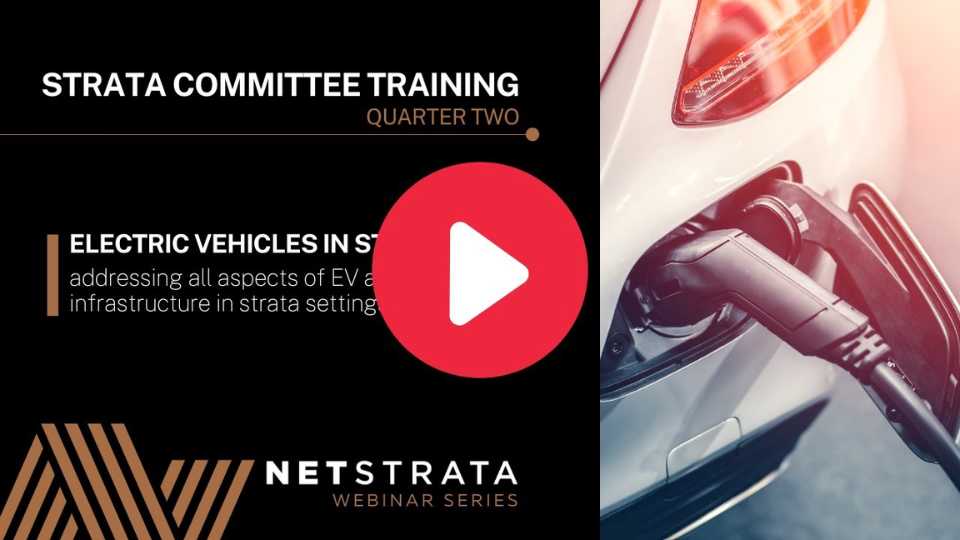
In this video, we break down the key challenges committees are facing and explore practical ways to approach them. We cover battery fire safety, common property charging rules, how by-laws can be used to regulate storage and EV infrastructure, cost recovery, and what committees can and cannot do under the legislation. Whether you're a committee member trying to set clear rules or an owner wanting to understand your obligations, this session gives you the tools to take a proactive and legally sound approach.
FAQ's:
During the session, we worked through a range of questions submitted by attendees. Below is a summary of the key questions raised and the practical guidance provided. For a full list of questions and answers, see the attached document at the bottom of this page - or send your own question to learning@netstrata.com.au and we'll get back to you.
Please note this is general information only and does not constitute legal advice, speak with your strata manager or a qualified professional for advice specific to your scheme.
Can we stop residents from charging e-bikes using common property power points?
Yes. Unauthorised use of common property electricity can be restricted by by-law, particularly where it creates a fire, safety or nuisance risk. The recommended approach is to use signage, notices and a by-law that bans charging from common property power without written approval from the owners corporation.
Who is responsible if a tenant's e-bike causes a fire?
The building insurer may respond first if common property is damaged, but who ultimately bears the excess or uninsured loss depends on the by-laws, the lease and the evidence of fault. A by-law should clearly address indemnities, excess recovery and responsibility for occupier conduct. In practice, the owners corporation would typically pursue the lot owner, who may then seek recovery from the tenant under the lease.
Can a by-law ban e-bikes and e-scooters entirely?
By-laws cannot be harsh, unconscionable or oppressive, and should not impose blanket bans without a strong building-specific safety basis. The better approach is to regulate — covering approved devices, charging locations, storage, evidence of compliance and cost recovery. A well-drafted by-law gives the committee clear authority without overreaching.
Is it safe to charge an EV using a standard 10A power point?
Potentially, but it depends on the outlet, circuit capacity, location, ventilation and the building's by-laws. A standard outlet may be lawful to use but still inappropriate for a particular building. A dedicated compliant EV circuit is generally the safer and more practical long-term approach.
What can a by-law actually cover for EVs, e-bikes and e-scooters?
Quite a lot. By-laws can regulate storage and charging on common property, set battery and charger safety conditions, create an approval process for EV charging works, deal with electricity cost recovery, manage shared EV infrastructure, and address unsafe behaviour and nuisance on common property. They cannot, however, block sustainability infrastructure purely to preserve the building's appearance.
Is it feasible to install EV chargers in individual garages?
Often yes, but the answer depends on switchboard capacity, cable routes, lot versus common property boundaries, fire safety design and metering arrangements. The recommended first step is an electrical feasibility review rather than assuming every garage can be treated the same way. A practical model used by many schemes is for the owners corporation to fund shared backbone infrastructure, with individual owners paying for their own final connection.
It's worth remembering that by-laws are a powerful tool, but they have limits. They cannot be harsh, unconscionable or oppressive, cannot be inconsistent with the Strata Schemes Management Act or other NSW law, and cannot be used to block sustainability infrastructure simply to preserve a building's appearance. The goal is not to prevent residents from embracing new technology, it's to ensure that as electric vehicles, e-bikes and e-scooters become part of everyday strata life, they do so safely, fairly and with clear rules that protect everyone in the building. If you have questions about how your scheme can get started, reach out to your Netstrata strata manager or email learning@netstrata.com.au.
















Related Files