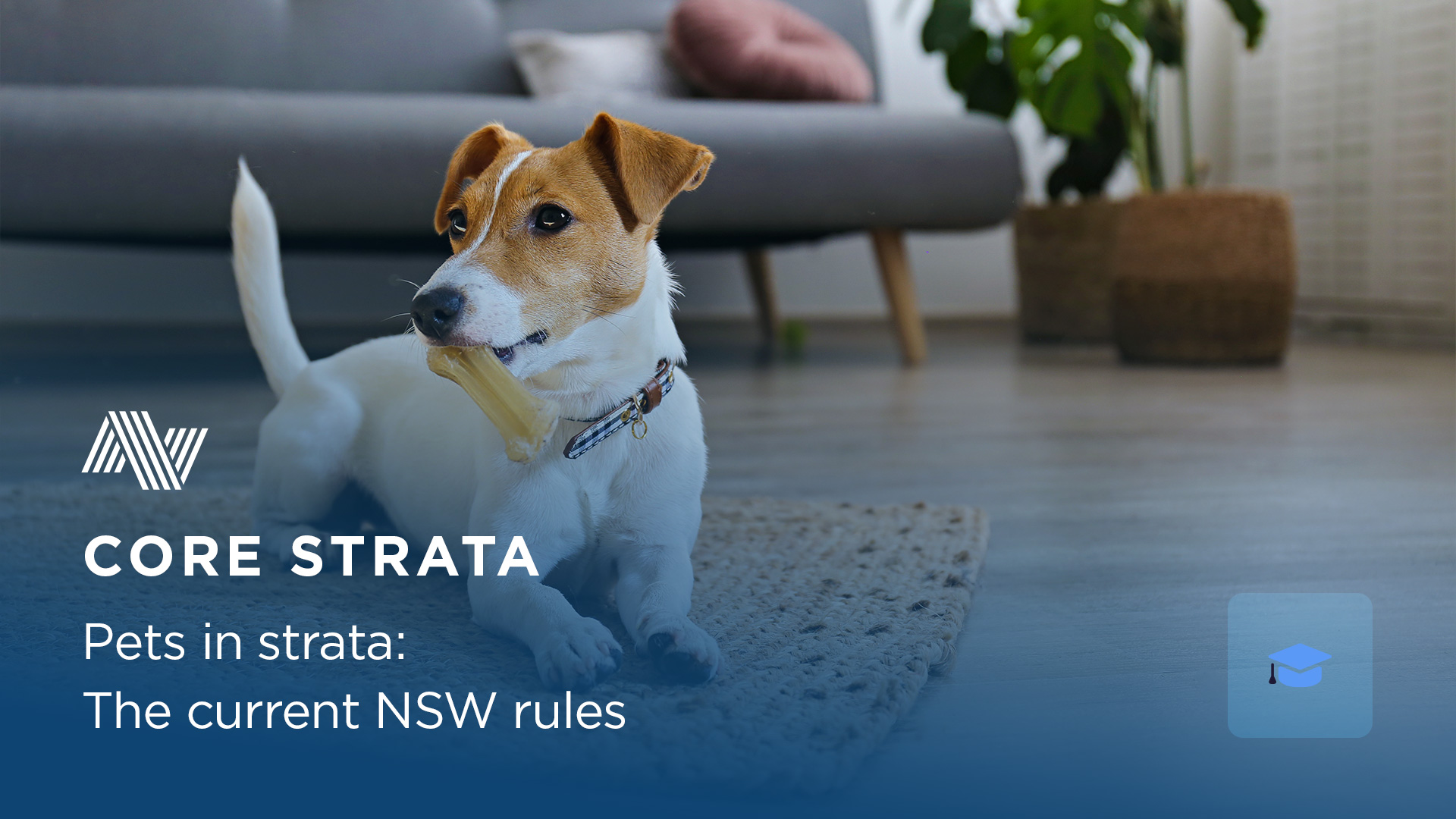
Pets in strata: The current NSW rules
Note: This article is intended as a general guide only, and should not be taken as legal or professional advice. It’s essential to consult with a qualified professional or seek advice from your managing agent if you have specific questions or concerns about strata living.
This version of the article was updated on .
The one-minute guide
The headline rule: Blanket bans on pets in NSW strata schemes are unlawful. An OC cannot enforce a by-law or make a decision that unreasonably prohibits keeping an animal on a lot.
The default position: It is deemed reasonable to keep a pet unless the animal actually causes unreasonable interference with another occupant's use or enjoyment of their lot or the common property. The law presumes in the pet owner's favour.
What OCs can still do: Require notice or written approval before a pet arrives. Set reasonable conditions on how pets are managed in common areas. Require pets to be supervised on common property and waste cleaned up.
What OCs cannot do: Ban all pets. Ban pets by size, weight, type, or number in most circumstances. Charge a bond, fee, or require insurance for keeping a pet.
If your pet causes problems: The OC can seek removal only if the animal actually causes unreasonable interference — persistent noise, chasing or attacking people, repeated property damage, or creating a health hazard. The proper process is a notice to comply, then mediation, then NCAT.
Tenants: You still need your landlord's consent (except for assistance animals). From 19 May 2025, landlords must respond within 21 days and can only refuse on permitted grounds. Non-response is automatic approval.
Assistance animals: Cannot be restricted by any strata by-law.
Few topics generate more strata disputes than pets. The law in NSW has shifted dramatically over the past five years, moving from a landscape where building-wide bans were common and enforceable, to one where blanket bans are invalid and the presumption runs in favour of pet owners. But the law does not give pet owners a free pass. Understanding exactly what you can and cannot do — and what the OC can and cannot do — is important for owners, occupiers, and strata committees alike.
| Audience | Relevance | Why it matters |
|---|---|---|
| Lot owners who have or want a pet | Essential | Understand what approvals you need, what by-laws your scheme can validly impose, and what happens if your pet causes problems. |
| Tenants who want a pet | Essential | Two separate approval layers apply: your landlord's consent, and potentially the OC's consent. This article explains both. |
| Strata committee members | Very important | Your OC cannot enforce a blanket ban. Understanding what you can legitimately require, and the process for dealing with problem pets, keeps the scheme compliant. |
| Investor owners | Important | Your tenant's rights to keep a pet may now be stronger than your building's by-laws contemplate. You may need to revise your pet policy. |
TL;DR: Blanket pet bans are unlawful in NSW strata. The law presumes it is reasonable to keep a pet unless it actually causes unreasonable interference. OCs can set conditions but cannot charge fees, bonds, or insurance. Tenants need their landlord's consent and, from May 2025, landlords must use a structured process with a 21-day response window.
How we got here: the law's evolution
For most of NSW strata's history, buildings could simply ban pets. By-laws that prohibited all animals were standard and routinely enforced. That changed with a series of court decisions and legislative reforms that fundamentally shifted the balance of power.
The Cooper case (2020)
The turning point was Cooper v The Owners — Strata Plan No 58068 [2020] NSWCA 250. Jo Cooper and her partner kept a half-blind, half-deaf miniature schnauzer named Angus in their Darlinghurst apartment, in breach of a by-law that banned all animals. The NSW Court of Appeal held that the blanket ban by-law was harsh, unconscionable, and oppressive, and therefore invalid. The Court found that a by-law cannot justifiably deprive owners of the use of their own property without some legitimate justification related to the wellbeing of other occupants.
Section 137B (from 25 August 2021)
Parliament codified the Cooper principles by inserting Section 137B into the Strata Schemes Management Act 2015. The key provisions are:
- Any by-law, or any decision by an OC under a by-law, that would unreasonably prohibit keeping an animal on a lot has no force or effect (s137B(1))
- It is taken to be reasonable to keep an animal on a lot unless keeping the animal unreasonably interferes with another occupant's use and enjoyment of their lot or common property (s137B(2))
- The regulations can specify circumstances that constitute unreasonable interference (s137B(3))
Regulation 36A: what counts as unreasonable interference
The Strata Schemes Management Regulation 2016 defines the circumstances that constitute unreasonable interference. An animal unreasonably interferes if it:
- Makes a noise that persistently occurs to a degree that unreasonably interferes with the peace, comfort, or convenience of another occupant
- Repeatedly runs at or chases another occupant, a visitor, or another occupant's animal
- Attacks or menaces another occupant, a visitor, or another occupant's animal
- Repeatedly causes damage to common property or another lot
- Endangers the health of another occupant through infection or infestation
These circumstances are based on actual, repeated behaviour — not hypothetical risk. A by-law cannot pre-emptively prohibit an animal on the grounds that it might one day cause one of these problems. The interference must have actually occurred or be occurring.
The ban on pet fees and bonds (from 11 December 2023)
Section 105A, inserted into the SSMA on 11 December 2023, prohibits OCs from imposing any bond, fee, or insurance requirement as a condition of keeping a pet. An earlier NCAT decision had allowed a $300 administration fee for pet applications (Roden, 2021). Section 105A overturned that. OCs can no longer charge anything — no application fees, no security bonds, no requirement that an owner or occupier take out pet liability insurance.
Stronger assistance animal protections (from 11 December 2023)
Section 139A was also inserted in December 2023 to clarify the rules for assistance animals. Assistance animals (dogs and other animals trained under the Disability Discrimination Act 1992 to assist a person with a disability) cannot be prohibited in any strata scheme, and by-laws cannot affect their ability to perform their duties. The OC can ask for evidence that an animal is an assistance animal — accreditation documentation, a statutory declaration confirming training, or similar — but cannot place restrictions on the animal in common areas that would undermine its assistance function.
TL;DR: Blanket pet bans became unlawful from 25 August 2021 under s137B. OCs can only restrict pets if they cause actual unreasonable interference. Pet bonds and fees have been prohibited since December 2023. Assistance animals have absolute protection.
What your scheme's by-laws might say
Every strata scheme has registered by-laws. The starting point for any pet question is always: what do your scheme's current registered by-laws say? Not all schemes have updated their by-laws since 2021, and some schemes still have older by-laws on title that technically impose broader restrictions. The key point is that regardless of what older by-laws say, section 137B overrides them: any provision that would unreasonably prohibit keeping an animal simply has no effect, even if it has never been formally amended.
The model by-law options
The Schedule 3 model by-laws introduced in 2016 give schemes two baseline options for pets:
| Option A (notification — the default) | Option B (approval required) |
|---|---|
| An owner or occupier may keep an animal on the lot provided they give the OC written notice within 14 days of the animal commencing to be kept on the lot. No approval is required — just notification. | An owner or occupier may keep an animal on the lot with the written approval of the OC. The OC must not unreasonably withhold approval. If approval is refused, the OC must provide written reasons. |
Both options require owners and occupiers to keep the animal within the lot, supervise it when it is on common property, and clean any areas of the lot or common property that are soiled by the animal.
Many older schemes have by-laws from the pre-2016 era that say something like 'an owner must not keep an animal without the OC's written approval, which must not be unreasonably withheld.' These older by-laws function similarly to Option B. The important thing is that in all cases, any refusal must be reasonable, and the post-2021 framework means 'reasonable' is now a high bar for the OC to meet.
What OCs can and cannot validly require
| OCs can validly require | OCs cannot validly require |
|---|---|
| Written notice that a pet is being kept on the lot (Option A by-laws) | A bond, fee, or insurance as a condition of keeping a pet (s105A SSMA) |
| Written approval before a pet is kept (Option B by-laws) | A blanket ban on all animals |
| Pets to be supervised at all times when on common property | Breed-specific bans (in most circumstances) |
| Pets to be carried or on a leash when in lifts or common areas | Weight or size restrictions (in most circumstances) |
| Waste to be cleaned up immediately | A limit on the number of pets (in most circumstances — see Bruce below) |
| Microchipping or vaccination evidence (for dogs and cats) | A requirement that the pet be desexed (in most circumstances) |
| Use of a designated entry/exit for pets | Refusal based on a hypothetical future problem rather than actual behaviour |
The Bruce decision: even a 'one pet' rule may be invalid
In Bruce v The Owners — Strata Plan No 98803 [2022], NCAT found that an OC had unreasonably withheld approval for an owner to keep a second dog (Peach, a French Bulldog), when the owner already had an approved dog and a bird. The OC refused simply because the owner already had a dog. NCAT held this was unreasonable — the question is whether the particular animal causes actual unreasonable interference, not whether the owner already has other pets. This decision signals that 'one pet only' type restrictions are vulnerable to challenge and may be unenforceable. OCs should assess each application on its own merits, not apply blanket numeric limits.
TL;DR: Check your scheme's registered by-laws. Most schemes use either a notification model or an approval model. Regardless of what older by-laws say, s137B overrides blanket bans. OCs cannot charge fees, bonds, or insurance. Breed, weight, size, and number restrictions are increasingly vulnerable to challenge.
How to apply to keep a pet
Step 1: Check your by-laws
Contact your strata manager and ask for a copy of the scheme's registered by-laws relating to animals. The by-law will tell you whether you need prior approval or just to give notice, what information is required, and any conditions that apply in common areas. Do not assume your scheme uses the model by-laws — many schemes have customised provisions.
Step 2: Submit the required notice or application
Under Option A by-laws: Give written notice to the OC (via the strata manager) within 14 days of the animal arriving. Include the type of animal and any details the by-law specifies.
Under Option B by-laws: Submit a written application to the strata manager before bringing the animal home. A typical application includes the type of animal, breed, age, weight, temperament, vaccination status, any training the animal has, and information about how the animal will be managed in common areas.
Step 3: Wait for a response (approval required schemes)
If your by-law requires written approval, the OC must decide within a reasonable timeframe. If the OC fails to respond within a reasonable time, or makes a decision that is inconsistent with the principles in s137B, section 137B(5) provides that the OC is taken to have given permission. What constitutes a reasonable timeframe is not defined in the Act, but strata lawyers generally consider that any delay of more than a few weeks without reason is likely to be unreasonable.
If approval is refused, the OC must provide written reasons. A refusal without reasons, or with reasons that do not relate to actual unreasonable interference, is itself vulnerable to challenge.
Step 4: Challenge an unreasonable refusal
If you believe the refusal is unreasonable, you have options:
- Write to the OC asking it to reconsider, with reasons why the refusal does not meet the s137B standard
- Apply to NSW Fair Trading for free mediation — this is the first formal step in the dispute resolution process
- Apply to NCAT under s157 of the Act for an order declaring you may keep the animal. NCAT can make this order if it is satisfied the OC has unreasonably withheld approval
Do not just get the pet and hope for the best
Some residents bring a pet home without applying, thinking 'what they don't know won't hurt them.' This strategy has real risks. If the OC issues a notice to comply and you are found to have a pet in breach of a by-law, you may face by-law enforcement action. The better path is always to go through the proper process. If the by-law cannot validly stop you, NCAT can make an order in your favour — and the OC may face costs orders for an unreasonable refusal.
TL;DR: Check your by-laws first. Notification schemes just need written notice within 14 days. Approval schemes need a written application before the pet arrives. If refused, the OC must give written reasons. Challenge an unreasonable refusal through mediation or NCAT.
Your obligations as a pet owner in strata
Having a pet in strata — whether by notification or with approval — comes with ongoing responsibilities. These apply to all owners and occupiers keeping an animal, regardless of the by-law type.
- Keep the animal within your lot: Your pet must live inside your lot. It cannot be left unattended on common property such as common garden areas or corridors.
- Supervise on common property: When your pet is in a common area (lobby, lift, garden, stairwell), you must be there with it. It must be on a leash or otherwise controlled. It cannot run unsupervised through the building.
- Clean up immediately: Any mess your pet makes anywhere on the lot or common property must be cleaned up promptly. This includes indoor areas if there is an incident.
- Prevent unreasonable interference: The ongoing standard is that your pet must not cause any of the five types of unreasonable interference specified in Regulation 36A: persistent noise, chasing behaviour, attacks or menacing, repeated property damage, or health hazards through infection or infestation.
- Comply with by-law conditions: Any conditions attached to your approval — such as using a designated entry/exit, microchipping requirements, or rules about specific common areas — must be followed.
If your pet does cause problems
If your pet causes problems — barking, aggression, or damage — address it proactively rather than waiting for a formal complaint. Talk to your neighbours. Engage a trainer if needed. The law is on your side while your pet is not causing actual unreasonable interference. If it is, you need to fix the problem, or the OC can legitimately pursue removal.
TL;DR: Pet owners must keep their animal in their lot, supervise it on common property, clean up after it, and ensure it does not cause the five types of unreasonable interference. Conditions in your approval also bind you.
Dealing with a problem pet: the OC's process
An OC cannot remove a pet simply because a neighbour complains about its presence or because they do not like animals. The only valid ground for pursuing removal is that the animal is causing actual unreasonable interference as defined in Regulation 36A. And even then, there is a process to follow.
Step 1: Speak to the pet owner informally
In many cases, the pet owner is unaware of the problem. Barking may occur when they are at work. A polite conversation can resolve many issues without formal action. The OC or strata manager should encourage direct communication between neighbours as the first step.
Step 2: Issue a notice to comply
If informal resolution fails and the problem continues, the OC can issue the pet owner with a formal notice to comply with the by-law. The notice must specify what the by-law breach is and what must be done to rectify it. The OC cannot jump straight to seeking removal without first giving the owner the opportunity to address the problem.
Step 3: NSW Fair Trading mediation
If the notice to comply does not resolve the matter, either the OC or any affected occupant can apply to NSW Fair Trading for free mediation. Mediation often resolves pet disputes without the cost and delay of NCAT proceedings. It is a mandatory first step before most NCAT applications in strata disputes.
Step 4: NCAT application for removal
If mediation fails, the OC or any affected occupant can apply to NCAT under Section 158 of the Act for an order requiring the removal of the animal from the scheme. NCAT will consider whether the animal has in fact caused unreasonable interference as defined in Regulation 36A. The burden of establishing this rests on the party seeking removal.
NCAT has power to make orders about the removal of the animal, or alternatively to make orders about the conditions under which it may be kept. In some cases NCAT may order that the animal remain but with specific management conditions rather than removal.
Attempting removal without following the process
An OC that tries to force removal of a pet without following the notice, mediation, and NCAT process risks facing costs orders and NCAT orders in the pet owner's favour. If the OC has also been charging pet fees or enforcing by-laws that are inconsistent with s137B, it may face additional adverse consequences. The process exists to ensure fairness to all parties — and it works.
TL;DR: Problem pets must cause actual unreasonable interference before the OC can pursue removal. The process is: informal conversation, notice to comply, mediation, then NCAT. There is no shortcut.
Tenants: navigating two layers of consent
Tenants who want a pet in a strata property face two separate approval requirements, each governed by different legislation. Both must be satisfied. One layer is the landlord's consent under tenancy law. The other is any OC approval required under the strata by-laws. These are independent — getting one does not automatically give you the other.
Layer 1: Your landlord's consent (since 19 May 2025)
Under the Residential Tenancies Amendment Act 2024, which commenced on 19 May 2025, a structured process now governs pet applications in residential tenancies:
- Apply using the standard form: Use the NSW Fair Trading Pet Application Form. All co-tenants must jointly sign the application.
- 21-day response window: The landlord has 21 days to respond. If no written response is given within 21 days, the pet is automatically approved without conditions.
- Grounds for refusal: The landlord can only refuse on permitted grounds, including that the pet is a restricted or prohibited breed, the property is genuinely unsuitable for the animal (for example, insufficient fencing or space), the number of animals is unreasonable (generally, 4 or fewer is not considered unreasonable), keeping the pet would cause damage likely to exceed the bond amount, or — importantly for strata — that the strata by-law has legal effect and prohibits the animal.
- Conditions: The landlord can impose reasonable conditions. Unreasonable conditions are void.
- Challenge: If you believe the refusal is on impermissible grounds or conditions are unreasonable, apply to NCAT within 28 days.
- No advertising 'no pets': It is now unlawful for a landlord or agent to advertise a property as not permitting pets.
Layer 2: The OC's approval or notification
Even after getting the landlord's consent, you may also need to comply with the OC's by-law requirements. If the strata by-laws require written approval, you will need to submit an application to the OC. If they require only notification, give written notice within 14 days. Your landlord cannot give you OC approval on your behalf — you must deal with the OC directly (usually through the strata manager).
If the OC refuses your application, the same dispute resolution pathway applies as for an owner: seek reconsideration, then mediation, then potentially NCAT. As a tenant, you will need your landlord's consent before applying to NCAT for a strata-related pet order.
Practical tip for tenants
The most common mistake tenants make is getting the landlord's approval and assuming that is enough. Check the strata by-laws as soon as you have your landlord's consent. If OC approval is also needed, submit that application promptly. Bringing a pet home and then discovering you also needed OC approval — and that the OC is disputing it — is a stressful situation that is easy to avoid.
TL;DR: Tenants need both the landlord's consent (under the new 21-day process from May 2025) and compliance with the OC's by-law requirements. These are separate. The strata by-law is a valid ground for landlord refusal. If both are satisfied, the tenant's rights are secure.
Assistance animals: a different category
Assistance animals under the Disability Discrimination Act 1992 (Cth) occupy a completely different legal position to companion pets. No strata by-law can prohibit an assistance animal from any scheme, and no by-law can impose conditions that would prevent the animal from performing its assistance functions. This is federal anti-discrimination law that overrides any strata by-law.
Section 139A of the SSMA (inserted December 2023) provides that an OC can ask a person who keeps an assistance animal to provide evidence that the animal is an assistance animal. Evidence that may be requested includes accreditation from a recognised assistance animal training organisation, a statutory declaration that the animal has been trained to the required standard, or similar documentation. But the OC cannot impose restrictions that undermine the animal's ability to assist its owner.
For tenants with an assistance animal, no landlord consent is required under tenancy law. You should still inform the landlord about the animal and provide evidence of its status, but you do not need to go through the formal pet application process.
TL;DR: Assistance animals cannot be prohibited or restricted by any strata by-law. The OC can ask for evidence of assistance animal status. Tenants with assistance animals do not need landlord consent under tenancy law.
Frequently asked questions
My building's by-law says no pets. Is it enforceable?
If the by-law amounts to an absolute ban on all animals, it has no force or effect by virtue of s137B(1) of the SSMA — regardless of whether it has been formally amended or repealed. You do not need to wait for the OC to update its by-laws. The statutory override applies automatically. However, the by-law may still impose other requirements (like an approval or notification process) that are valid and that you should comply with. Seek clarification from your strata manager about what the valid requirements are under your current by-laws.
Can the OC ban large dogs?
In most circumstances, no. Weight or size restrictions on dogs (for example, 'no dogs over 12kg') are not related to actual unreasonable interference and are unlikely to be enforceable. The relevant question is whether a particular animal's behaviour causes actual problems in the scheme, not its size. A large, well-trained, quiet dog may cause far fewer problems than a small, aggressive, noisy one. Size-based restrictions are increasingly vulnerable to challenge under s137B.
The OC approved my previous pet. Do I need new approval for a new pet?
Generally, yes. Approval for a specific animal is typically animal-specific and does not automatically transfer to a new or additional animal. Pet approval is granted for the individual animal, not as a blanket entitlement to keep any pet at any time. Check your scheme's by-laws for the specific requirements, and apply for approval or give notice for any new animal.
The OC approved the previous owner's pet. Does that apply to me as the new owner?
Generally, no. Approval is typically granted to a specific person for a specific animal. A new owner of the lot starts fresh and would need to apply under the scheme's current by-laws for any pet they wish to keep. This is sometimes a surprise for purchasers who expected the pet approval to transfer with the property.
Can the OC ask me to pay a pet bond or deposit?
No. Section 105A of the SSMA expressly prohibits OCs from imposing bonds, fees, or insurance requirements as a condition of keeping a pet on a lot. If your OC's by-law or approval letter includes a pet bond or application fee requirement, that condition has no legal force. You should raise this with your strata manager.
My neighbour's dog barks all day. What can I do?
Start by speaking to the dog's owner. They may not be aware the dog barks while they are away. If that does not work, contact the strata manager who can advise the OC to issue a notice to comply. If the barking constitutes persistent noise that unreasonably interferes with your peace, comfort, or convenience (as defined in Regulation 36A), this is a valid ground for the OC to pursue through the dispute resolution process. Keep a log of incidents — dates, times, and duration — to support a formal complaint if one becomes necessary.
I want to keep a cat. Do I need approval?
It depends on your scheme's by-laws. If your by-law uses the Option A notification model, you simply need to give written notice within 14 days of the cat arriving. If your by-law uses the Option B approval model, you need written approval from the OC first. Either way, the OC cannot unreasonably refuse, and a cat that does not cause any of the Regulation 36A interference types would be very difficult to refuse. Check with your strata manager for the specific requirements in your scheme.
Can I have a fish tank or small caged birds?
Fish tanks and caged birds are generally considered very low-risk animals in strata. Some older by-laws specifically permitted small caged birds without requiring approval. Under the current framework, even if a by-law purported to require approval for a goldfish tank, refusing such approval would almost certainly be unreasonable under s137B given the negligible risk of interference with other occupants. Speak to your strata manager about the specific by-law requirements in your scheme, but the practical answer is that small aquatic and caged animals are rarely a source of meaningful strata dispute.
TL;DR: Blanket bans have no effect even without formal amendment. Size and weight restrictions are vulnerable to challenge. Approvals are animal-specific, not blanket. OCs cannot charge fees or bonds. Persistent barking is a legitimate ground for action through the proper process. Check your specific by-laws for notification or approval requirements.
Important
This article provides general guidance on pet rules in NSW residential strata schemes as at April 2026. The law in this area has changed significantly since 2020 and continues to evolve. The scheme's specific registered by-laws always determine what requirements apply in practice. Schemes that have not updated their by-laws since before 2021 may still have provisions on title that are invalid under s137B — but identifying exactly what is and is not valid requires analysis of the specific by-law. Relevant legislation: Strata Schemes Management Act 2015 (NSW) — Section 105A (no fees/bonds/insurance); Section 137B (keeping of animals); Section 139A (assistance animals); Section 157 (NCAT order permitting keeping of animal); Section 158 (NCAT order for removal). Strata Schemes Management Regulation 2016 (NSW) — Regulation 36A (circumstances of unreasonable interference); Schedule 3 Model By-Law 5 (keeping of animals). Residential Tenancies Act 2010 (NSW) as amended by the Residential Tenancies Amendment Act 2024 — pet application process commenced 19 May 2025.



















Related Files